
A peptide blend is a single research preparation that combines two or more peptides, so they can be studied together instead of one at a time. Researchers reach for blends because most biological questions involve several signals working at once, and a single peptide can only answer one piece of the puzzle. A catalog entry such as kylopeptides.com/product/klow shows how a blend is specified as one defined product for laboratory use only. Think of it as a layered approach: one layer gives you a clean baseline, while stacked layers show how components interact.
This article explains where singles and blends each fit in study design, and what quality and handling details matter before either goes on the bench. We’ll also walk through a clearly labeled hypothetical scenario. Everything here is framed as laboratory research, grounded in integrity and careful verification rather than unsupported claims.
What a Combined Peptide Blend Means in Plain Language
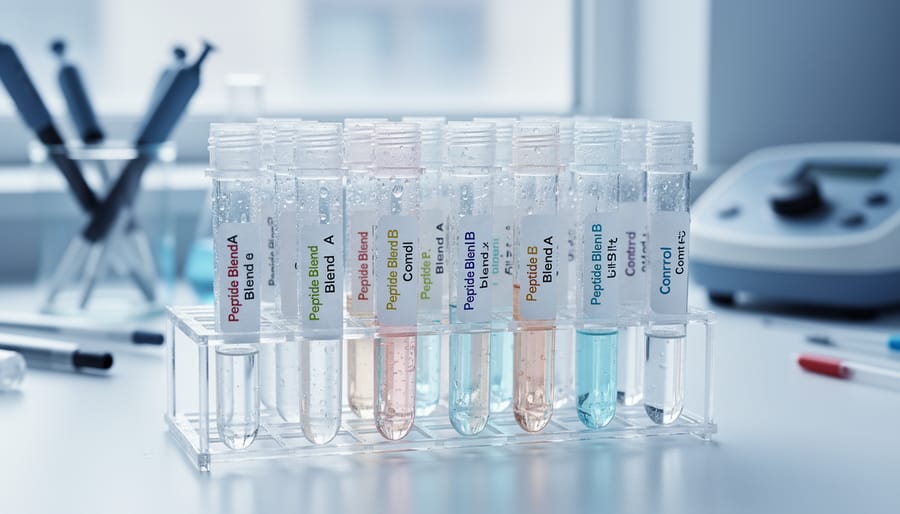
A peptide is a short chain of amino acids, the same building blocks that form proteins, only much smaller. In a laboratory setting, researchers can prepare a peptide on its own or alongside others, and that choice shapes how a study is designed.
Think of it like a layered security plan. A single safeguard, such as a quality lock, can do its job well. But when you add cameras, lighting, and monitoring, you start to see how the pieces work together. Blends give researchers a similar view of how components behave in combination.
These are laboratory research materials, and a blend is defined by what it contains and in what amounts, not by any promised result. The glossary below covers the core terms.
- Peptide
- A short chain of amino acids linked together, smaller than a full protein.
- Single-peptide preparation
- A research material containing one peptide, often used to isolate a single variable.
- Combined blend
- A preparation containing two or more peptides that are studied together.
- Ratio/concentration
- The proportion of each peptide in a blend and how much is present in a given volume, which should always be documented.
- Synergy
- A hypothesis that peptides may behave differently together than alone, something to be tested rather than assumed.
- Control group
- A comparison arm, such as a single peptide or no treatment, that lets researchers judge whether a blend changes anything.
Keeping these definitions clear helps researchers describe exactly what was tested, which is the foundation of any trustworthy comparison.
How Blends Fit Into Research Design
Studying Interactions Between Peptides
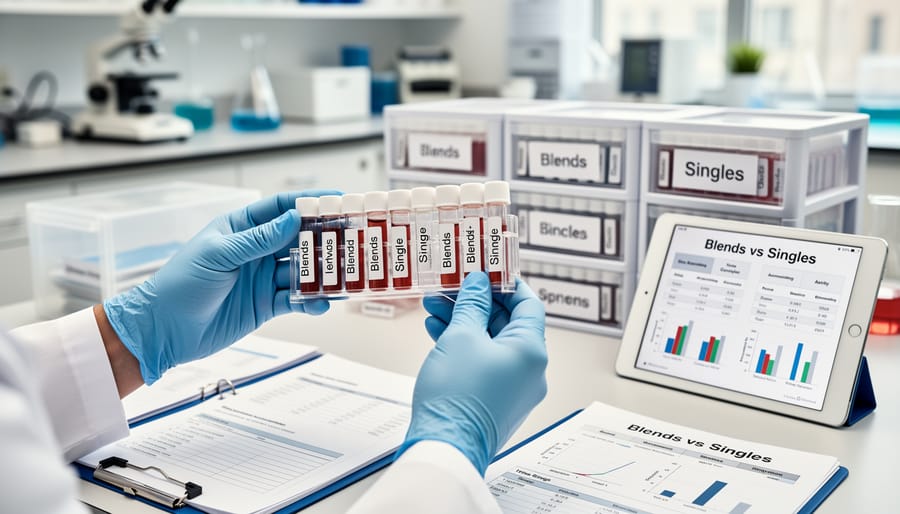
A blend lets researchers ask a question a single peptide can’t answer: do these compounds behave differently together than alone? Observing that difference is the whole point, and it only holds up when the comparison is built correctly. Teams often borrow the discipline of a secure operations framework where every step is defined, documented and checked before conclusions are drawn.
Researchers typically choose blends for a handful of practical reasons:
- Examining how peptides interact within the same model.
- Exploring multiple pathways at once.
- Keeping preparation consistent from run to run.
- Running more efficient protocols.
- Comparing the blend directly against single-peptide arms.
That last point matters most. Without a single-peptide control arm, any observed effect could belong to one component, and the blend gets credit it hasn’t earned. Running each peptide alone alongside the combination makes attribution clear, so interaction effects are measured rather than assumed.
Consistency and Efficiency in the Lab
In the lab, small preparation differences can quietly skew results. A pre-defined blend lets a team work from one documented composition, so every vial starts from the same ratios rather than from several separate weighing and mixing steps. Fewer hands-on steps means fewer places for variation to creep in, and it makes a protocol far easier to repeat from one run, or one researcher, to the next. That consistency matters because standardization improves reproducibility which is the foundation of trustworthy findings.
None of this works without good records. Look for a certificate of analysis that confirms purity and identity, clear labeling of each component and its ratio, and batch numbers you can trace. Verifying those details before a study begins, and logging them alongside your results, is what turns convenience into dependable science.
Singles Versus Blends: Where Each Approach Fits
A single peptide is usually the right tool when the goal is isolation. If a team wants to know what one compound does on its own, a single-peptide preparation keeps the question clean. There is one variable, one concentration, and one source of any observed effect, which makes attribution straightforward. Singles also serve as the baseline. Before anyone can say a combination behaves differently, someone has to document how each component behaves alone.
Blends earn their place when the question itself is about combination. If researchers hypothesize that two peptides act on complementary pathways, testing them together is the only direct way to observe that. A blend also suits layered hypotheses, where the interest lies in how components relate to one another rather than in any single contribution. The tradeoff is that attribution gets more complex, so the design has to account for it with single-peptide control arms.
Neither approach is better in the abstract. The method should follow the question. It resembles how a security team applies a framework like the use-of-force model: the response is chosen to fit the situation, and it isn’t applied the same way every time. In practice, many research programs use both. They begin with singles to establish clarity, then move to blends to explore interaction, with each stage documented so results can be reproduced and trusted.
How Blends Are Used in Practice: A Research Scenario
The following is a hypothetical scenario, not a real study, and it uses no actual institutions or data. It simply shows how a team might structure the work.
Imagine a small lab asking one question: does Peptide A behave differently in a cell model when it is combined with Peptide B? First, the team writes the question down and fixes what they will measure. Then they build their arms: a vehicle-only control, a Peptide A arm, a Peptide B arm, and a blend arm. Without the two single arms, any difference in the blend arm couldn’t be attributed to the combination.
Next comes documentation. The team records each peptide’s lot number, certificate of analysis, concentration, and the exact blend ratio, plus storage and preparation steps. When the runs finish, a second researcher reviews the raw results before anyone interprets them, and the team repeats the experiment to check consistency.
None of this is glamorous, but it’s the point. A methodical, documented process is what lets others trust and reproduce an outcome, much like a well-kept security log lets you trust a site report. For genuine case studies, look to published, peer-reviewed literature rather than summaries or anecdotes.
Quality, Handling and Responsible Sourcing
Responsible researchers treat quality as the foundation of any peptide study, whether they work with a single compound or a blend. The first thing to look for is third-party testing. A certificate of analysis from an independent laboratory should confirm identity and purity, and it should match the lot you actually received. If the document is vague or missing, that’s a reason to pause before using the material.
Labeling matters just as much. A clearly labeled blend lists every component along with its ratio, so the preparation can be reproduced and the results can be interpreted. Without that detail, even careful experiments are hard to verify.
Storage deserves the same attention. Many peptides are sensitive to temperature, moisture, and repeated handling, so following supplier guidance on storage and documenting how materials are kept helps protect their integrity over time.
Finally, stay aware of the regulations that apply to your work and your location. Research peptides are intended for laboratory research only, not for human or veterinary use. Choosing transparent suppliers and keeping good records reflects the same integrity and vigilance that careful, layered approaches depend on in any field.
Common Questions About Peptide Blends
Are blends always better than singles?
No. A single peptide is often the better tool when a team needs to isolate one variable or establish a clean baseline. The right choice depends on the research question.
Why do researchers test singles first?
Singles show what each peptide does on its own. That baseline makes it possible to tell whether a blend behaves differently from its parts.
How are ratios decided?
Ratios usually come from the study’s hypothesis and prior published work. They are then fixed and recorded so the protocol can be reproduced.
What should a certificate of analysis include?
Look for the identified components, their stated ratios, purity results from independent testing, and a batch or lot number.
Documentation ties all four answers together. Clear records of composition, ratios and testing let a result be checked and repeated, and that is what makes a research outcome dependable.
Combined blends and single peptides each answer a different kind of research question. Blends help teams explore how compounds behave together and can simplify handling across a protocol, while singles give the clarity and clean baselines needed to attribute an effect to one variable. Neither is better in every case. The right choice comes down to study design, the question being asked, and how carefully the work is documented.
That mirrors how we think about protection at Montreal Security Services. A thoughtful, well-documented, coordinated approach, where each layer is understood and verified, produces results you can depend on. If that way of working appeals to you, and you’d like to bring it to a career in security, we invite you to join our team and explore the other resources we’ve prepared for you.